Academic · 2026
Biochar pavilion
An architecture that disappears
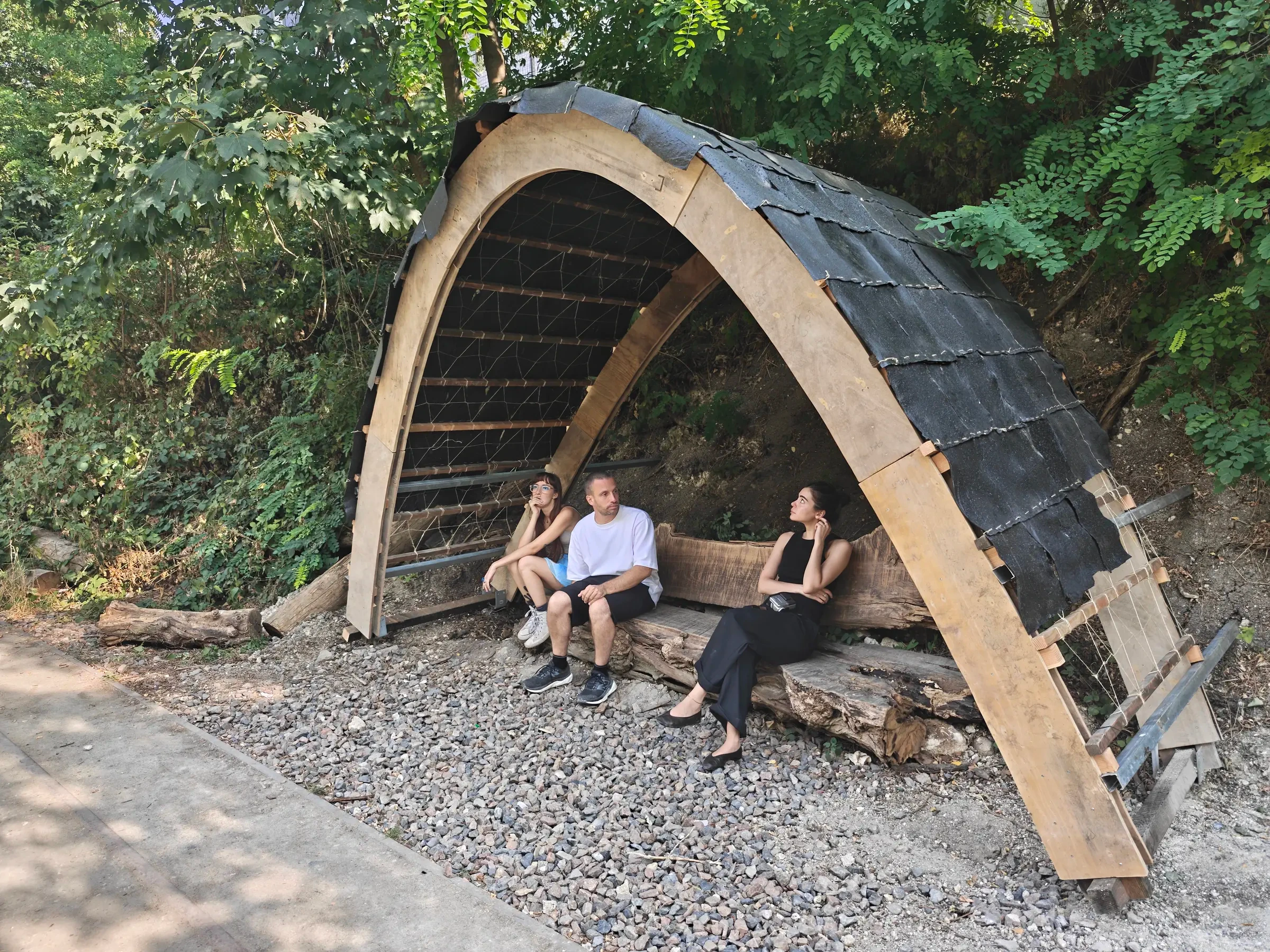
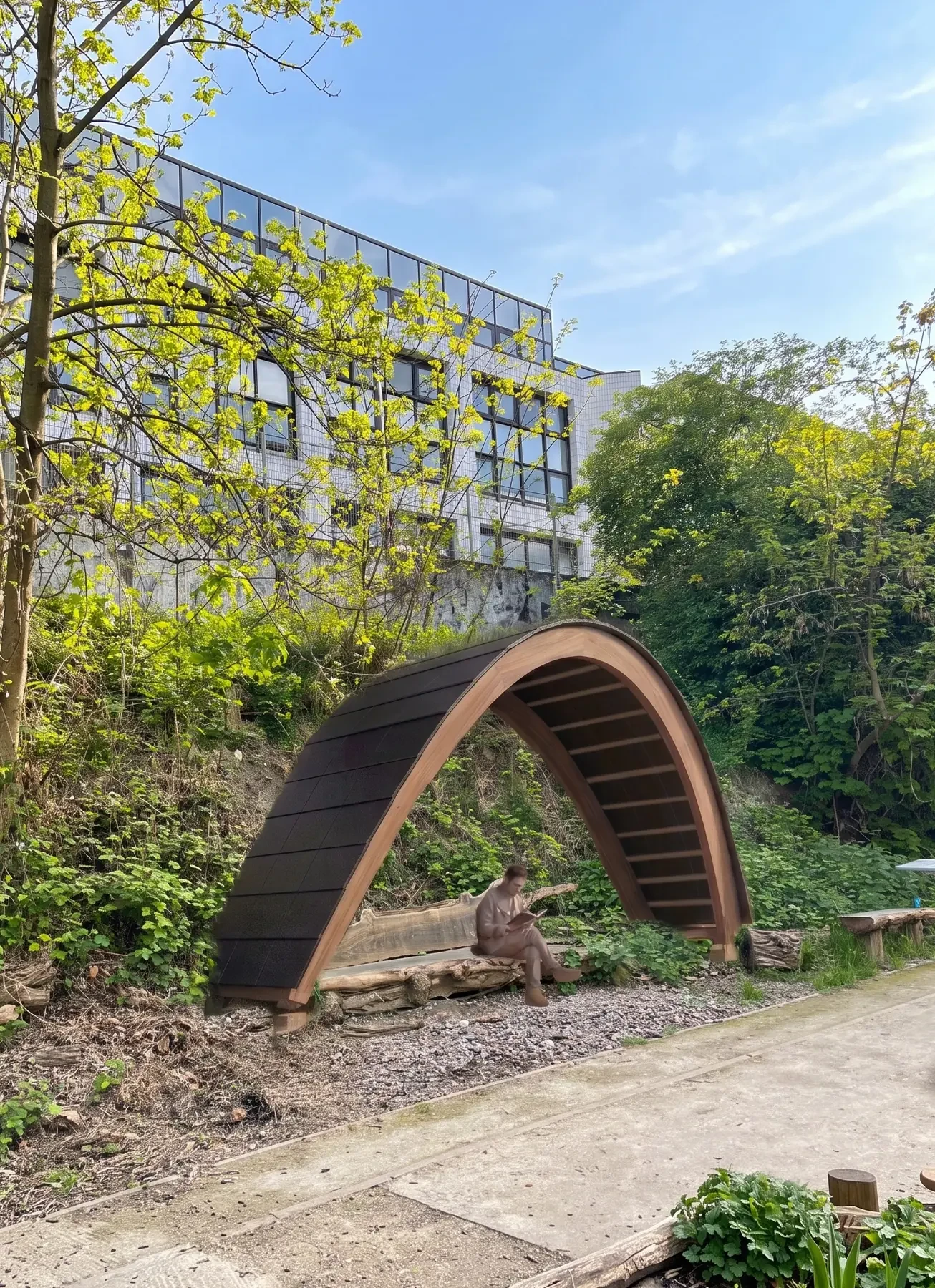
An arch set on the Petite Ceinture, Paris’s old circular railway. Its skin cleans the soil as it decomposes into it.
- Location
- Jardin des Traverses, Petite Ceinture, Paris
- Year
- 2026
- Role
- Author: design and construction
- Practice or school
- Master’s diploma project, Digital Matters, ENSA Paris-Malaquais
- Status
- Built
3D model of the pavilion: an arch of bent timber planks on foundations, carrying battens and blocks, clad in black membranes. The sequence shows it in plaster, in its materials, exploded layer by layer, as a line drawing, then in plan.
01
Building light on ground that already carries too much
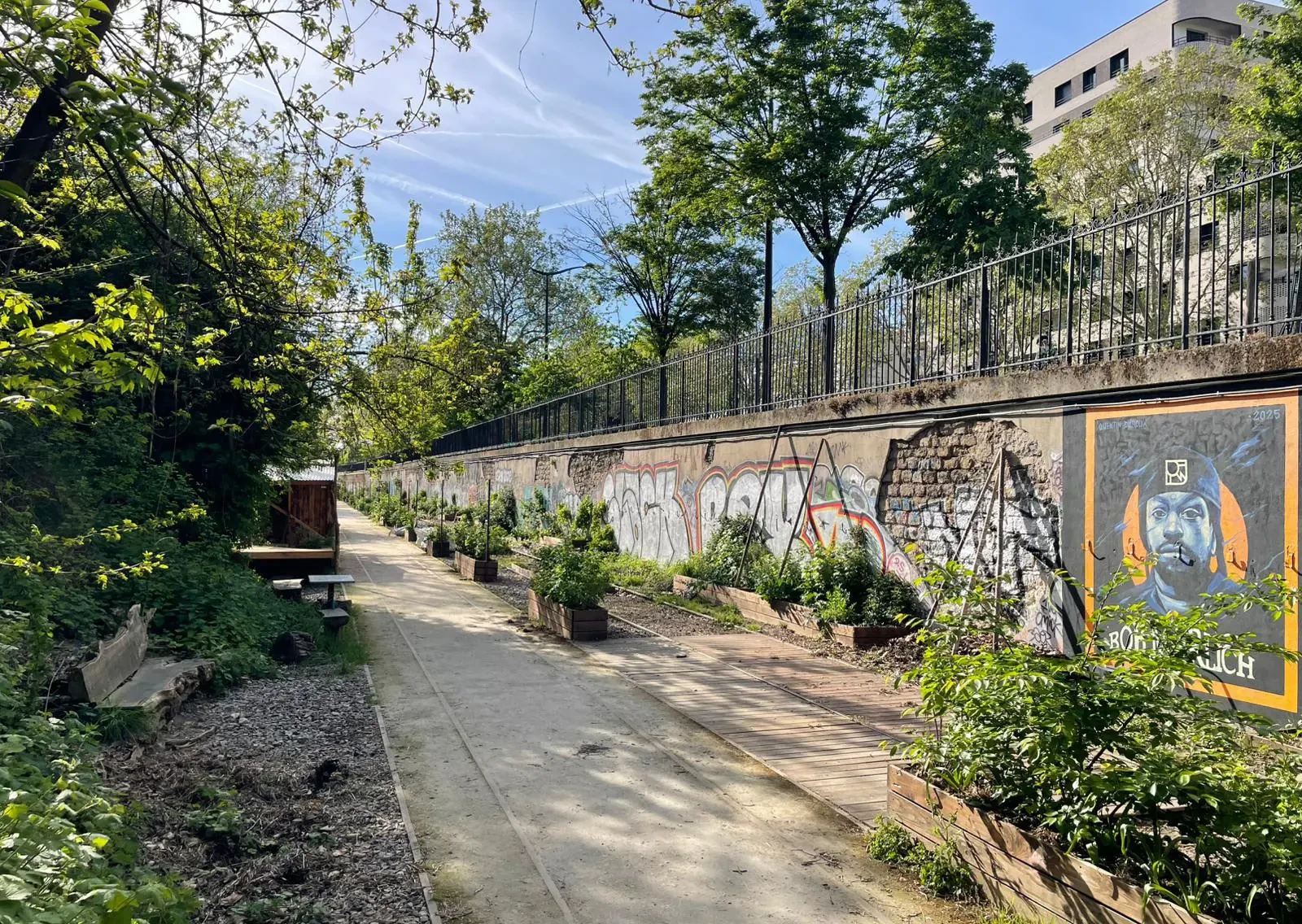
The Jardin des Traverses is a community garden laid on the old track of the Petite Ceinture. Its sleepers were treated with creosote, and the soil still holds heavy hydrocarbons.
02
A skin that works as it disappears
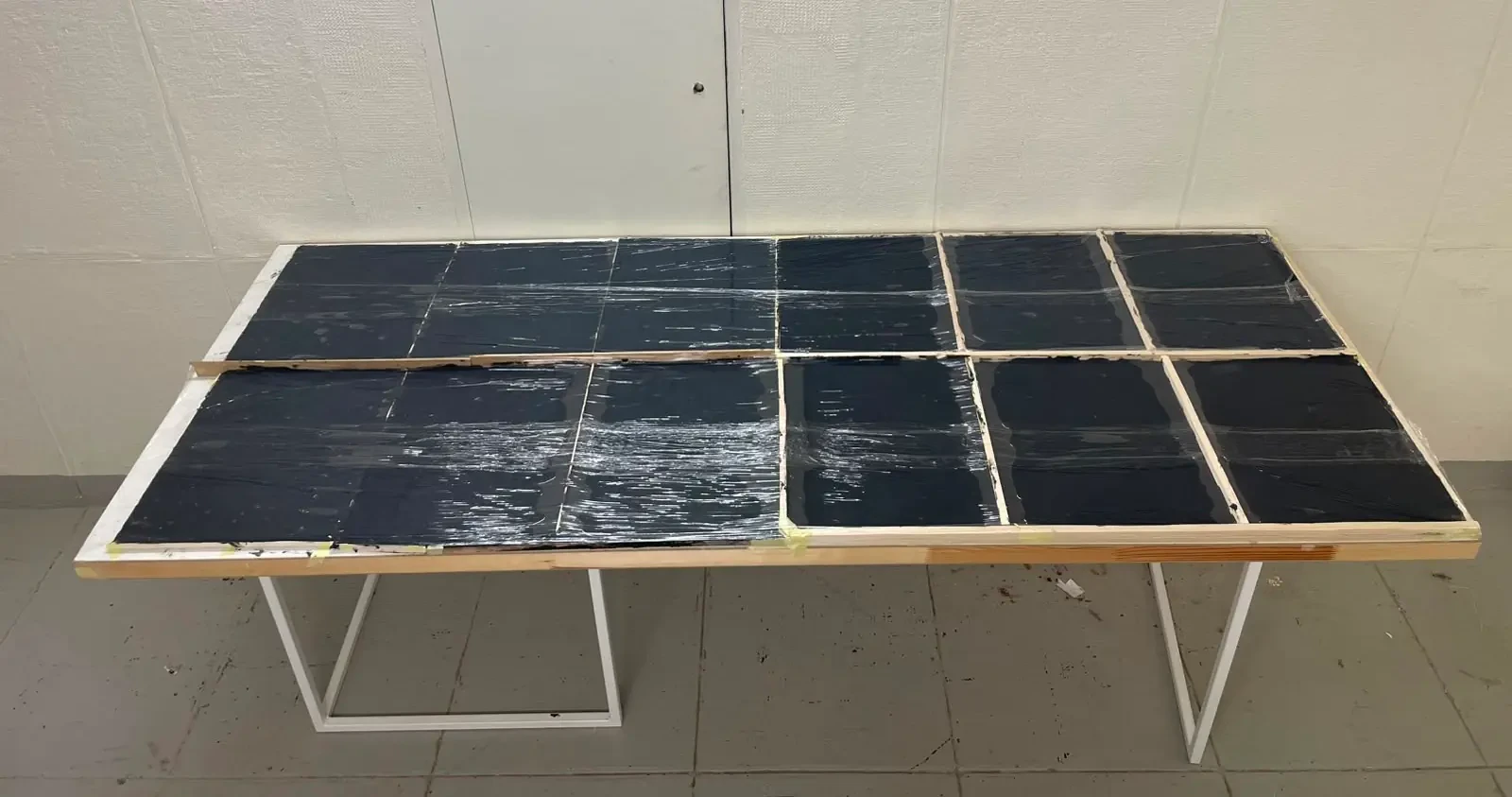
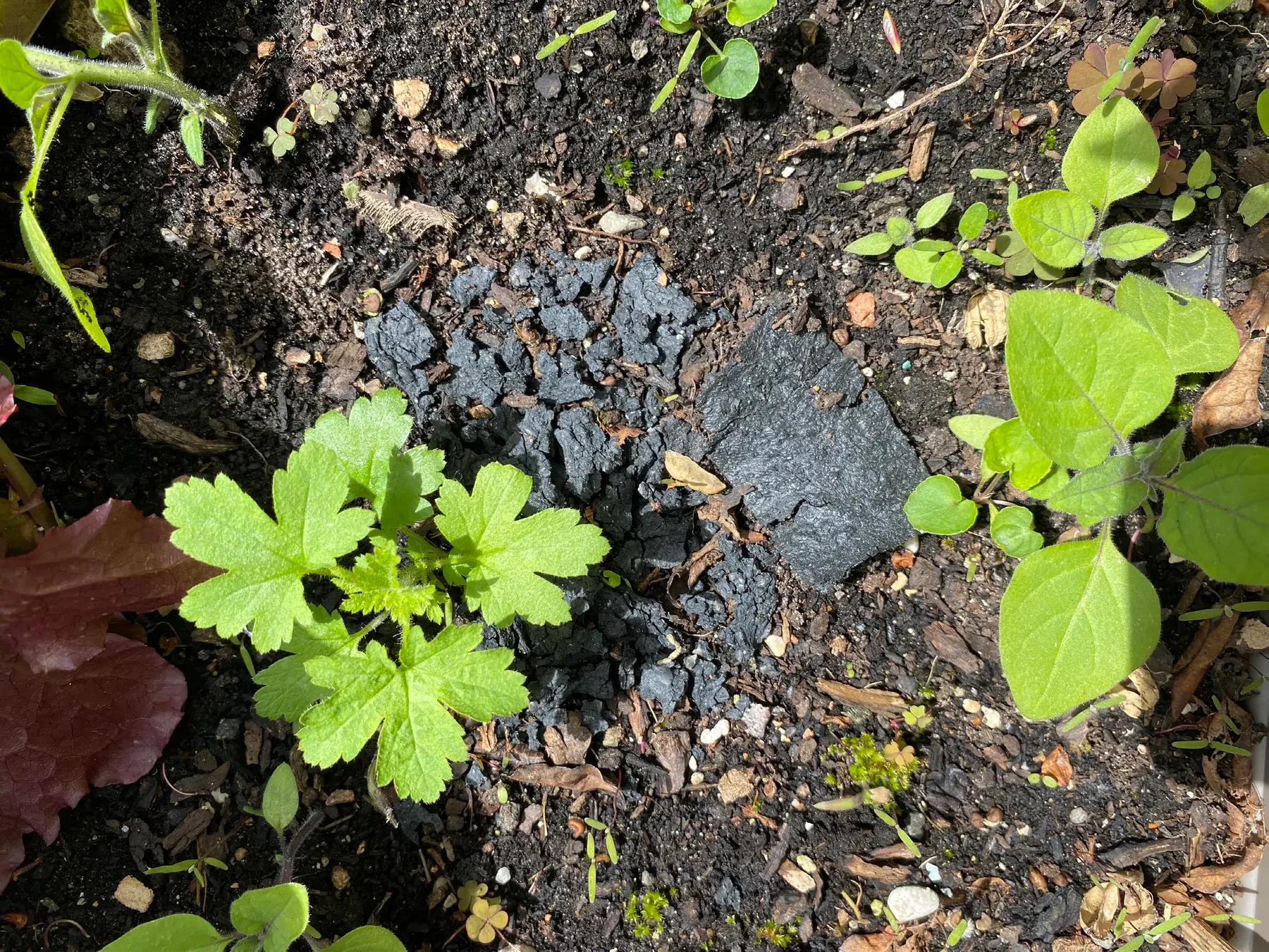
The membrane is a flexible sheet loaded with biochar, a microporous plant charcoal. Laid on the frame, it keeps out water, protects, and regulates heat.
03
Sewn with hemp thread
The membranes are sewn one by one with hemp thread and laid on the arch in large patches.
04
One arch, four layers
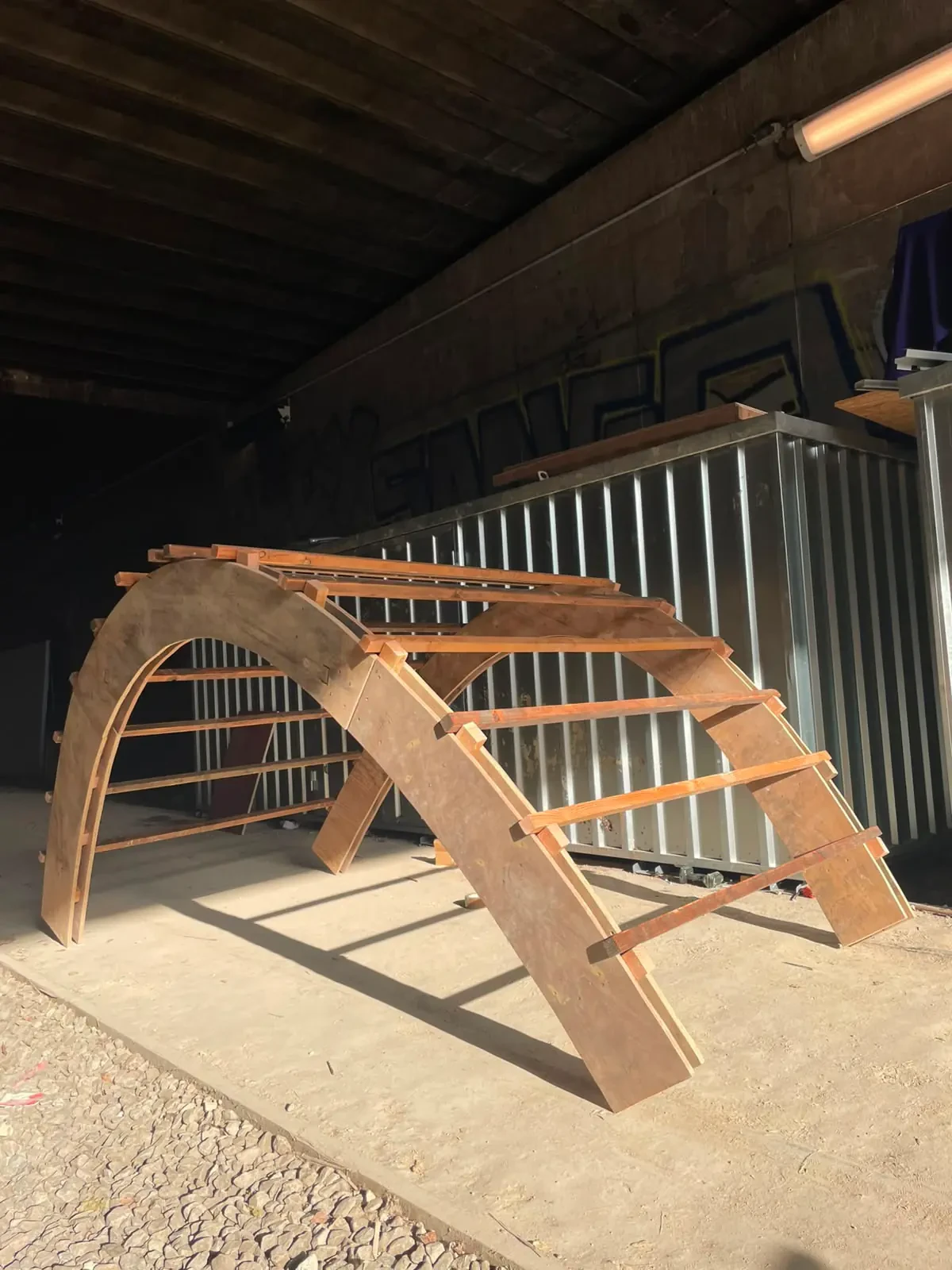
Construction starts with the foundations, then comes the frame, and last the membranes.
An arch of bent timber planks, with a 70 × 70 joist. It was first trial-assembled in the workshop.
Battens of 40 × 40 and blocks of 40 × 60 or 40 × 40 carry the skin on the arch.
How long the membranes last depends on their thickness. Then they break up under moisture and micro-organisms, and the biochar stays in the soil.
05
Drawing the end
The end of the building is not an accident to put off. It is a phase of the project, drawn like all the others.
06
On tracing paper
A horizontal cut at one metre, and the pavilion becomes an architect’s drawing again.
Creosote is a wood preservative classified as carcinogenic. For a long time it protected railway sleepers all over Europe; the Petite Ceinture still bears its trace, even though its embankments are now cultivated.
Building there in the usual way would add permanent matter to ground that already carries too much. The project turns the problem around: the building becomes the agent of the clean-up.
Credits
Tutors: Frank Minnaert, Anahita Mirani, Minh Nguyen, Nicolas Leduc